

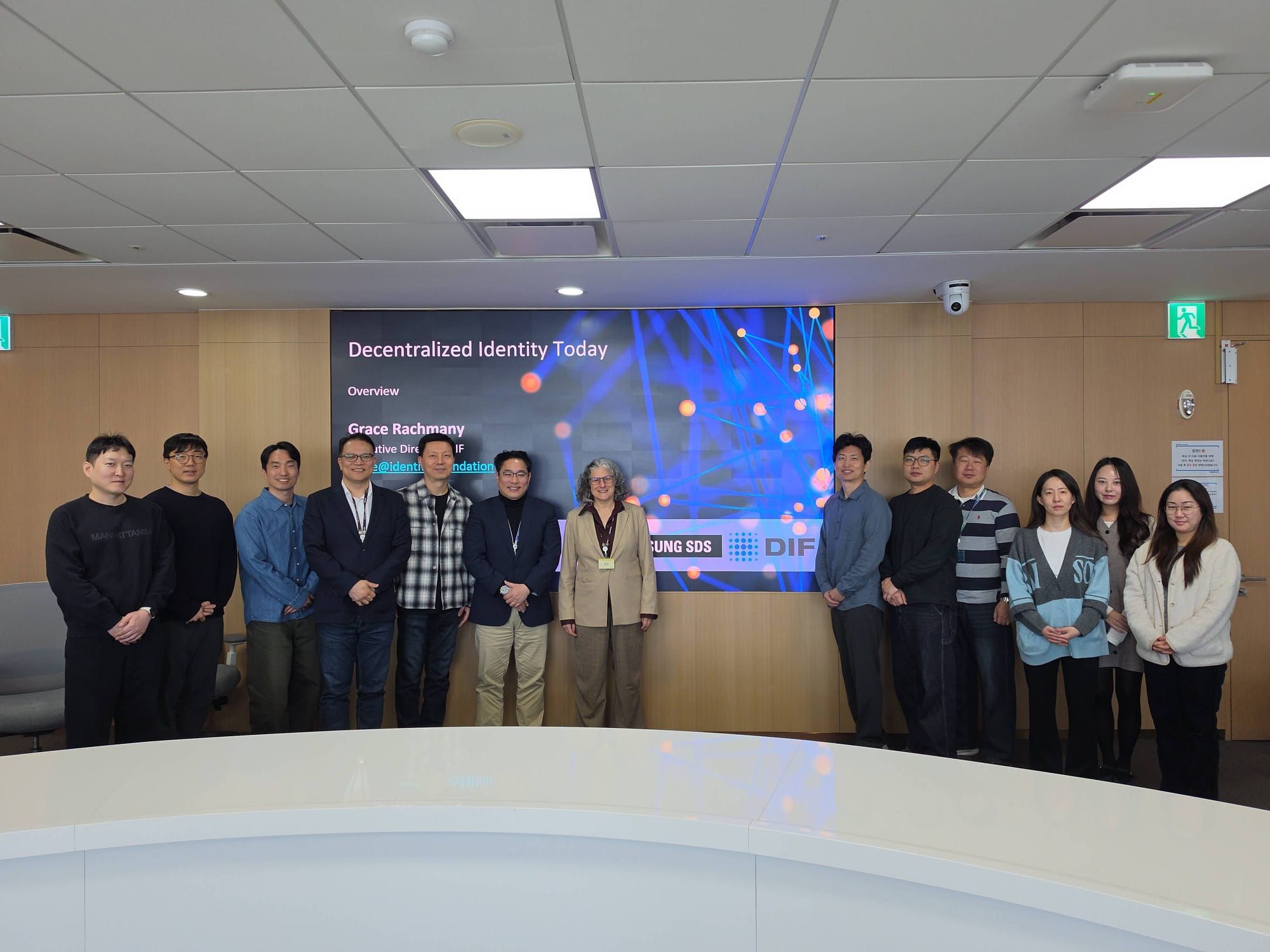
For historical reasons, DIF has been focused on Europe and North America for much of its activities, with membership coming mostly from those countries. In the first quarter of 2026, we made a concerted effort to explore other parts of the world, participating in two conferences in Africa (MOSIP Connect and DID Unconf Africa), and with visits by the Executive Director to Singapore, Japan, Korea, and China. The Hot Takes conversations with DIF members are the place to go to hear more about the Africa experiences. This blog post focuses on the Asia trip. Grace will be hosting a Hot Take on (date/time) for member Q&A on the Asia visit.
Korea: DIDs for Agentic AI and Human ID
In Korea, we met with five organizations working on different aspects of identity using DIDs. We had reached out to Raon Secure Corporation, aware that their OpenDID project had formed the baseline for human identities both with government institutions and in business applications. The Raon team presented their Agentic AI framework using DIDs and we left the meeting agreeing that DIF would welcome the work in our Trusted Agentic AI Working Group, working together towards a DID-based specification for Agentic AI. This contribution aligns well with the work already being done with the contribution of VouchedID, which Raon had already evaluated. Raon has joined DIF as a contributing member and we are looking forward to collaborating across these compatible frameworks to create robust standards for Agentic AI based on DIDs and VCs.
Samsung SDS warmly hosted a presentation by DIF ED Grace Rachmany, focusing on the EUDI wallet, including the recently-released Business Wallet. The meeting was arranged by DIF’s Special Interest Group leader, Kyoungchul Park of K4 Security Co. The team at Samsung SDS focused on the implications for the financial sectors. The group also discussed the relevance of decentralized technologies for government and business cases. We discussed the potential deployment trajectory for eIDAS, the large-scale trial results in Europe, and how different member states were rolling out identity wallets. In terms of the large-scale trial, we discussed both the implications for fraud reduction as well as what acceptable rejection rates for users should be, given that users are currently relatively satisfied with their existing national wallets.
Leadpoint Systems hosted DIF at a meeting including Dark Matter Labs and Arthrium. Leadpoint has deployed a blockchain DID-based system for the islands of Incheon, which includes a large range of services from single sign-on, to membership credentials, ecological action incentives, and an IP-registration service. The IP registration service was particularly innovative, giving citizens of Incheon the ability to register new ideas that could evolve into future technologies. Arthrium is working on a gift economy system for higher redemption rates of gift cards to stimulate local business. The Dark Matter Labs team is looking at practical applications for AI in permissioning municipal systems for community stewardship of public spaces. DIF gave a presentation on considerations for civic infrastructure for identity, voting, and community currencies.
Perhaps one of the most striking things about Korea was the level of care for guests. It reminded me of a time when business wasn’t just about money, but about the people in your environment. While the Koreans do work extremely long hours, they were always gracious, had time to take me to breakfast and/or lunch, provided refreshments at the meetings, respectfully exchanged business cards, and gave symbolic gifts. Kyoungchul from K4 even met me at the airport and dropped me off at the express train. It’s been a very long time since I had such gracious hospitality.
China IETF
The visit to Shenzhen, China, focused around the Internet Engineering Task Force (IETF) meeting. The IETF holds three annual meetings in rotating locations, and it had been 16 years since they had met in China. Although there were serious concerns about the way the internet had to be set up (IETF sets up a clean internal system wherever it has meetings), the timing was impeccable. China leads in 68 of 74 critical technologies, and it’s currently still possible to travel to China. There were some visa issues, particularly for those attending from India, but the meetings are held in such a way that remote participants can join all of the sessions.
Interest in DID technology is quite robust in China, and at IETF we saw several hackathon entries in the area of Agentic Identity, some of which used DIDs as identifiers. One of the most encouraging projects we saw was the Agent Network Protocol, which is using DIDs as identifiers for AI Agents. The team was enthusiastic about collaboration, so if you’re reading this and you’d like to hear more, DIF can introduce you to the team there (or you can reach out directly).
Approximately 17 side events were held on the topics of AI and Agentic AI. The sponsors included Huawei, China Mobile, and China Telecom, all of whom were working on approaches to Agentic AI. The IETF hasn’t determined yet where Agentic AI belongs within the working groups. One of the main points of contention is the lack of definition of an AI Agent.
At the mini-expo held by the hosts, we saw two different implementations which exemplified the concern. China Telecom showed an Agentic AI system where they were using agents to perform specific tasks around network operations and optimization. All of the Agents were deployed and controlled by the organization on its own behalf, and they had dedicated purposes. In this configuration, China Telecom was using its own proprietary identification system for each agent, and there was no issue of delegation and responsibility. Within a closed system, this architecture makes sense. China Mobile, on the other hand, perceived Agents as being deployed by the subscribers to China Mobile. They were working with a protocol based on binding the Agent identity to the SIM of the user, and it sounded like they were still working out affordances for porting of phone numbers to a different provider. There were a few mentions of alternative approaches for Agentic AI in some of the working groups, but generally, the IETF was inconclusive about where Agentic AI proposals belonged within the organization, so much of what was proposed ended up in dispatch limbo.
Singapore and Japan: Continued support with existing members
The Singapore visit included discussion with existing member Affinidy and new member Aven. In Japan the meetings included discussion with private companies. Furthermore, a few contacts made at the Network School in Malaysia joined as Contributing members.
Next steps and lessons learned
The primary success of the trip was due to prior history with the groups we met in Korea and Singapore. We have several new Contributing and potential Associate members to the organization, particularly to the Trusted Agents Working Group. As with any new technology, there is still debate about the best approach for identifying Agents, but DIDs and VCs appear to have major advantages over other types of identifiers, particularly when it comes to Agent interoperability across different contexts.
In China and Japan, we failed to contact our prior connections, which naturally can happen with a new ED (myself). We will be making efforts in the coming months to organize our outreach efforts so we can better leverage DIF member connections worldwide.
Given the success in recruiting new members, DIF plans on implementing continued outreach campaigns in the coming months. We’ll be starting close to home, getting a better handle on our internal databases and implementing a CRM system. We’ll then be able to engage in conversations with existing and potential members to grow participation.