

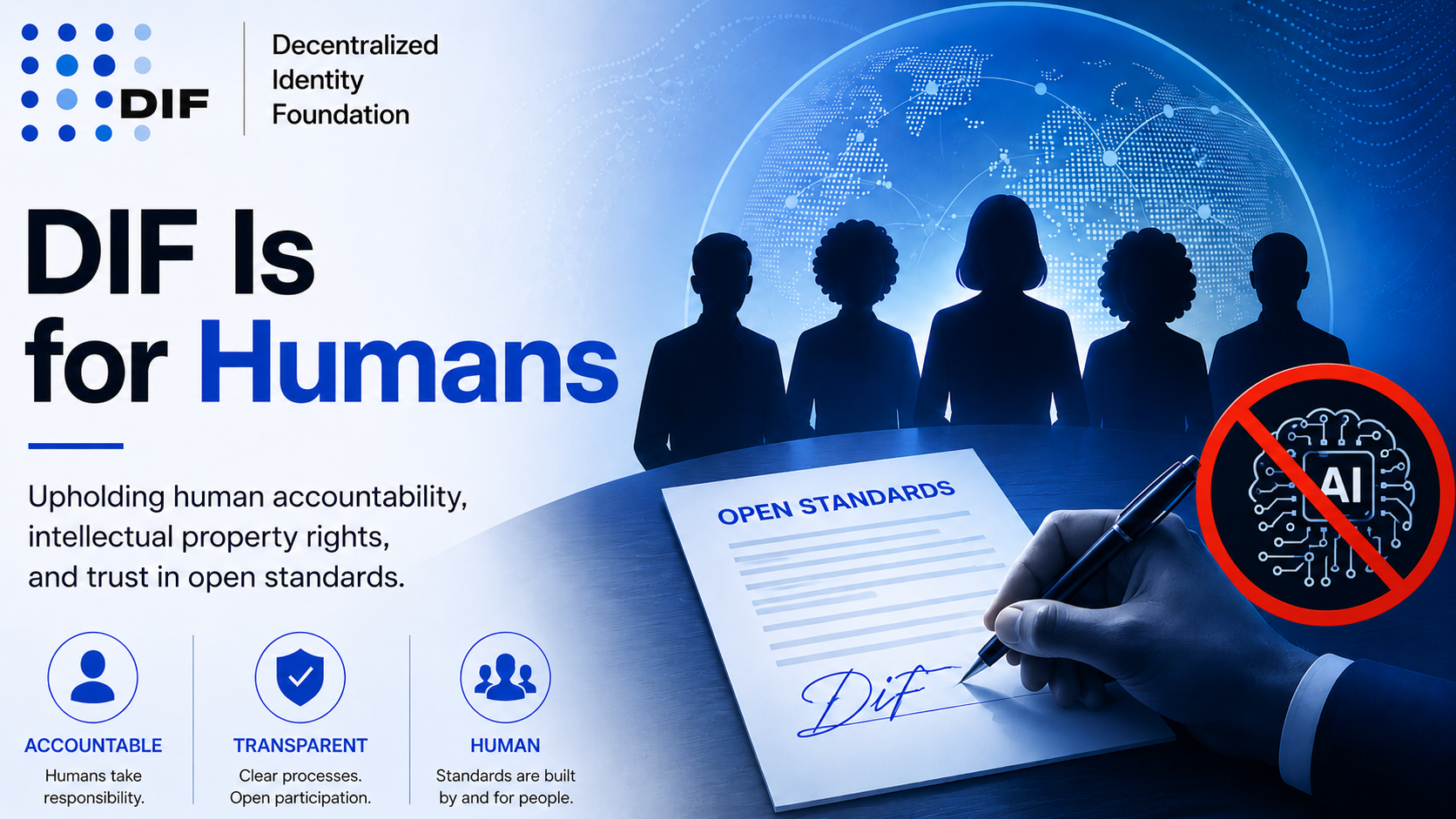
Two small but major changes to AI policy have been integrated into DIF’s governing documents. While other organizations are struggling to agree on how to deal with Agent participation on their mailing lists, chat channels, and repositories, the Decentralized Identity Foundation has taken a rapid and decisive stand based on our Intellectual Property Rights policy.
DIF Bans Agents
Agentic AI contributions are banned from DIF.
DIF Upholds Creator Rights
DIF has been maintaining its leadership in developing standards for trusted AI and trusted content with two working groups, so we are pro-AI and pro-Agent. However, maintaining moral rights is at the center of the standards being developed in DIF. LLMs today do not respect the provenance and source of the information they provide, and therefore they may not participate in DIF mailing lists, discussions, or code repositories.
This decision was the recommendation of DIF’s Technical Steering Committee and passed unanimously by the elected Steering Committee.
Precedent Set: Provenance Is Key
We hope this decision will be a precedent to other standards bodies. We cannot base international standards on materials that do not have clear legal standing, and that do not have adequate accountability attached to them. Therefore, the Steering Committee has taken a hard line against direct participation and contributions from large-language models and AI Agents.
Backstory: Insightful and Pleasant Agents
Recently, a number of DIF’s working group mailing lists have received insightful emails from a friendly and knowledgeable AI Agent. This prompted the Technical Steering Committee to discuss the nature of this type of participation, and whether it was appropriate for an AI Agent to join the mailing lists. Other organizations are dealing with the same problems. In fact, in some of the larger Standards Development Organizations, they are experiencing so much agentic content, it's become difficult to follow the conversation in their mailing lists.
While many of us feel that AI can potentially provide benefits to bodies such as DIF, not one person was able to make an argument for how we could ensure adherence to basic attribution of intellectual property rights. The ongoing violations of copyright and trademark by LLMs make it clear that accepting such contributions could endanger the legal status of the standards, reports, and code contributions that DIF provides for the industry. Therefore, the Technical Steering Committee made the recommendation to ban such traffic from all DIF mailing lists, and furthermore to ban direct AI participation and contributions to any DIF repositories. The Steering Committee approved the recommendations, which have now become part of DIF’s Code of Conduct and Working Group Lifecycle document.
DIF has chosen to take a clear non-ambiguous stance against direct AI contributions, primarily because it is impossible to determine the intellectual property rights status of text or code contributed by LLMs in their current form. Today’s LLMs are prone to inadvertently violating copyright and intellectual property laws, and research into making LLMs aware of moral rights is going even more slowly than researching into making them morally aware. Furthermore, even if an LLM does make original contributions, it’s unclear who owns the copyright to the output of the LLMs and agents, or if ANY moral rights can be held on LLM outputs.
Even when the person deploying the agent is clearly identified, DIF’s Technical Steering Committee has asserted that the confidence level is too low to accept such contributions. Similarly, if an Agent suggests ideas in the discussion groups, and those ideas are adopted by the working groups, there is a danger of inadvertent IPR violation, because such ideas fall outside of DIF’s current agreements and monitoring systems. As well as being clear on the policy level, this is a values-based decision. DIF defends the rights of those who have generated original ideas and code, whether those are companies or individuals.
Appropriate use of AI at DIF
Despite the ban on Agentic AI contribution, DIF recognizes the importance of using AI and LLMs in certain circumstances. In the inclusivity section, we have stipulated specifically that people can use AI for translation, particularly if they are not native English speakers. We also recognize that people may use AI for other types of assistance, including coding or help writing specifications. While such uses are not explicitly banned, we are explicit about the fact that all contributions to DIF are consciously and carefully made by humans.
Each human who makes a contribution to DIF is fully responsible for releasing those contributions under the open source licensing employed by DIF. Just as someone might ask a friend for help, or outsource code writing, DIF cannot constrain individuals from using AI for help on their contributions. However, the individual must be fully responsible for all legal implications of any contributions they make to DIF.
Code of Conduct Update
In DIF’s Code of Conduct, the section previously called “Open, Inclusive, and Diverse” is now titled “Open, Inclusive, Diverse & Human”. The language has been updated to include the following:
- “Though we welcome people fluent in all languages, DIF development is conducted in English. Participants that feel functional but disadvantaged in English should feel comfortable requesting to bring coworkers to meetings or tap bilingual participants/colleagues or artificial intelligence to assist in language translation or perform side discussion during meetings."
- "Human: Though diverse, DIF is an organization of diverse humans. Membership is reserved for individual humans and organizational employers of humans. AI agents are not allowed to join or contribute to DIF independently.”
Working Group Lifecycle Update
The Working Group Lifecycle has been updated with section 9 as follows:
“Agentic Contributions to DIF Working Group Products. Working group members are encouraged to think of agentic contributors (whether LLMs or otherwise) as introducing a risk of violating patent rights. There is a risk that an LLM could reference, depend on, or include content that is not available under any license that is compatible with open standards and open source. Direct contributions from independent AI tools are not allowed. WG chairs are asked to add a clause to their project's contribution guides requiring that all contributions be signed off by humans who can reasonably attest to and honor the IPR obligations that were agreed to when joining DIF. In all cases, contributions to DIF WG projects must be put forward by DIF members; contributions from any agent acting autonomously must not be accepted.”
Next Steps
Based on these policies, DIF will roll out changes to the charters of all Working Groups and update the Working Group Charter template for future groups. Working Group chairs will be informed of the policy and approve the changes to the charters of each group.


